admin@yugongequipment.com


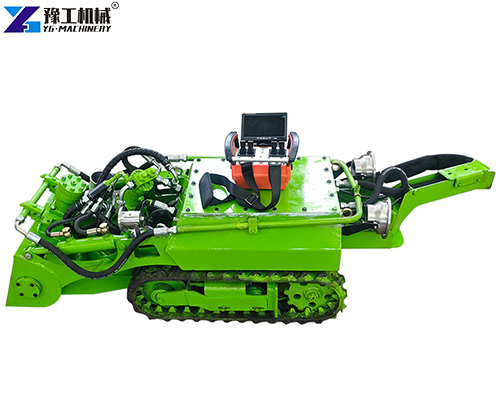
How to efficiently complete silt cleaning of closed tanks while complying with French occupational safety and environmental protection regulations is a key concern for many European engineering contractors. In this French project, the YG submersible dredging robot successfully replaced manual confined-space work. It achieves fully enclosed sludge transport and on-site sand-sludge separation throughout the whole process. Let’s look at the field construction case of this sludge cleaning robot.
Hot-Selling YG Dredging Robot for Sale
| Model | YG500 Electric | YG600 Electric | YG700 Electric | YG800 Electric | YG900 Electric | YG1200 Electric |
| Robot Dimensions | 1500×500×650 mm | 1500×600×650 mm | 1600×700×650 mm | 1600×850×700 mm | 1650×960×750 mm | 1900×1200×750 mm |
| Slurry Pump Model | 3E-100Z170 | 3E-100Z170 | 4E-250ZJ45 | 4E-250ZJ45 | 4E-250ZJ45 | 4C-200Z125 |
| Cleaning Width | 500 mm | 600 mm | 700 mm | 800 mm | 900 mm | 1200 mm |
| Track Speed | 3–15 m/min | 3–15 m/min | 3–15 m/min | 3–15 m/min | 3–15 m/min | 3–15 m/min |
| Robot Weight | — | — | — | — | — | 500 kg |
| Pump Inlet Size | 3 inch | 3 inch | 4 inch | 4 inch | 4 inch | 5 inch |
| Pump Flow Rate | 100 m³/h | 100 m³/h | 160 m³/h | 160 m³/h | 200 m³/h | 200 m³/h |
| Pump Head | 0–30 m | 0–30 m | 0–25 m | 0–25 m | 0–25 m | 0–25 m |
| Hydraulic Station Dimensions | 2200×1200×1700 mm | 2200×1200×1700 mm | 2200×1200×1700 mm | 2200×1200×1700 mm | 2200×1200×1700 mm | 2120×1240×1200 mm |
| Main Motor Power | 18 kW | 18 kW | 22 kW | 22 kW | 22 kW | 45 kW |
| Hydraulic System Pressure | 0–16 MPa | 0–16 MPa | 0–16 MPa | 0–16 MPa | 0–16 MPa | 0–16 MPa |
| Max Particle Size | 15 mm | 15 mm | 40 mm | 40 mm | 50 mm | 60 mm |
| Winch Speed | 0–10 r/min | 0–10 r/min | 0–10 r/min | 0–10 r/min | 0–10 r/min | 0–10 r/min |
| Standard Hydraulic Hose Length | 50 m | 50 m | 50 m | 50 m | 50 m | 50 m |
| Control System | Wireless Remote Control | Wireless Remote Control | Wireless Remote Control | Wireless Remote Control | Wireless Remote Control | Wireless Remote Control |
| Lighting System | 2× Underwater LED Lights | 2× Underwater LED Lights | 2× Underwater LED Lights | 2× Underwater LED Lights | 2× Underwater LED Lights | 2× Underwater LED Lights |
Challenges of Silt Cleaning at Confined Facilities in France
An environmental engineering contractor in France took over a silt treatment project including sedimentation tanks, closed tanks, and supporting pipelines. The site has limited space. Tanks and manholes are typical confined-space working environments. The main on-site pain points are as follows:
- Strict safety management: Under local French labor safety regulations, approval procedures for personnel entering tanks are complicated. Tanks contain major safety hazards such as toxic hydrogen sulfide gas and drowning risks. Manual entry into manholes carries extremely high risks.
- Heavy pressure for environmental acceptance: Traditional dredging requires excavating silt to the ground for stockpiling. It easily releases odors, and leachate causes secondary pollution, making environmental assessment acceptance difficult.
- Restricted access for traditional equipment: Conventional large dredging machines have large overall dimensions and cannot enter narrow tanks for dredging work.
- Uncontrollable construction schedule: Silt transfer involves complicated procedures. Multiple construction steps extend the timeline, and project costs tend to exceed budgets.
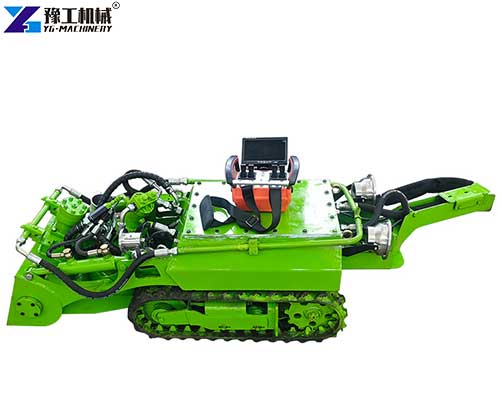
To avoid safety risks and meet environmental requirements, the customer urgently needed automated equipment that can work underwater, be remotely controlled and deliver enclosed sludge transport, namely sludge cleaning robot, to replace traditional manual dredging. After comparing multiple options, the customer finally chose the YG brand submersible dredging robot to complete sludge breaking, collection, transport, and solid-liquid separation in one stop. The YG800 electric tracked model was selected for this project, with an operating depth covering 30–90 meters.
Deployment and On-Site Operation Process of YG Submersible Dredging Robot
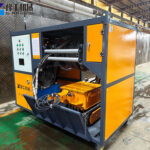
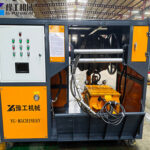
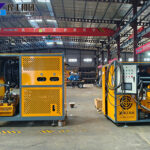
The full submersible dredging robot system includes the underwater robot body, hydraulic power station, oil delivery lines, and mud transport pipelines, paired with a control workstation and back-end processing unit. On-site deployment and operation process:
- Equipment setup: The on-site technical team completes installation and commissioning of the whole system and lays control cables, oil pipes, and mud transport pipelines.
- Underwater travel operation: This sludge transport robot moves steadily on the tank bottom via a tracked chassis. Operators remotely control the robot on shore. Its working head cuts, stirs, breaks, and gathers settled sludge at the tank bottom.
- Enclosed transport and treatment: Sludge never touches the ground. It is continuously sent through sealed pipelines by the suction system to the back-end processing unit for solid-moisture separation and sludge volume reduction, realizing enclosed sludge transport.
- Visual monitoring: An optional underwater camera is used in this project. Operators view real-time underwater working footage and precisely adjust robot posture and working efficiency.
YG800 Electric features an 800mm cleaning width, 22kW main motor power, slurry pump flow up to 160m³/h, maximum passable particle size of 50mm, wireless remote control system, and underwater LED lighting.
Core Technology of Submersible Dredging Robot
This sludge cleaning robot adopts an environment perception system made up of LiDAR, vision cameras, and ultrasonic sensors, with autonomous positioning and intelligent obstacle avoidance functions. With the wireless remote monitoring system, operators can monitor the robot’s running status on shore in real time. The equipment can be fitted with multiple working tools: high-pressure water jets scour hard sediments, cutting heads break caked sludge, and mechanical arms grab debris such as plastic bags and branches; the suction system transports sludge and sewage out. Compared with traditional dredging methods, this equipment is specially designed for closed tanks and underwater enclosed scenarios, with outstanding performance for narrow-space operations. According to working conditions, optional accessories include agitation suction heads, auger tillers, raking arms, and buckets. The suction system supports self-priming, pumping, auger, and other working modes.
Measurable Results Achieved at the French Project Site
- Fully eliminate risks of personnel entering confined-space tanks, fully complying with French occupational safety standards;
- Full pipeline-enclosed sludge transport, sludge kept off the ground to stop secondary pollution;
- Shorten on-site construction period and greatly reduce on-site solid waste volume;
- Cut overall project costs and simplify environmental acceptance procedures.
The complete submersible dredging robot achieves “the system keeps running, no personnel enter tanks, sludge stays off the ground, and mud, sand, and water get separated”. It perfectly solves the pain points of closed-tank dredging.
Multi-scenario Applications & Optional Configurations
The YG series sludge transport robot applies to a wide range of scenarios: municipal drainage pipeline and manhole dredging; ecological dredging for lakes and reservoirs; dredging of chemical storage tanks and sedimentation tanks at wastewater treatment plants. The equipment offers two power options: electric and diesel models. Customers may select explosion-proof motors (essential for flammable and explosive chemical sites), underwater high-definition cameras, and high-pressure water pumps as needed. Its working depth ranges from 30 to 90 meters, suitable for sediment cleaning of various tanks, pools, and culverts.
Buying Submersible Dredging Robot for European Dredging Projects
If you need a submersible dredging robot for tank, pipeline, or storage tank dredging projects in France or other regions in Europe, please contact us for customized on-site solutions, quotations, and full sets of technical documents.