admin@yugongequipment.com



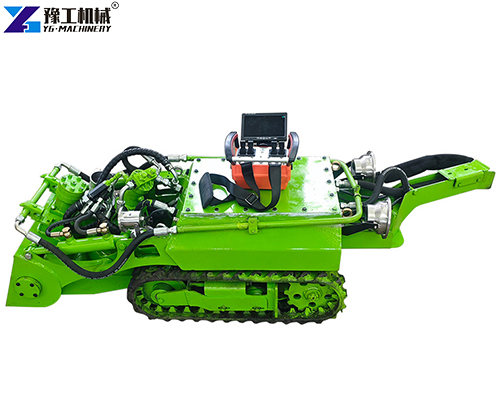
Efficient sludge removal is becoming essential for Chilean facilities seeking to improve water recovery, reduce disposal volumes, and meet stricter environmental expectations. By deploying an underwater crawler cleaning robot, the customer was able to remove accumulated sludge without man-entry, convey it through a closed pipeline, and prepare it for downstream separation and volume reduction.
Underwater Crawler Cleaning Robot Parameters
| Model | YG500 Electric | YG600 Electric | YG700 Electric | YG800 Electric | YG900 Electric | YG1200 Electric | YG1500 Electric |
| Robot Dimensions | 1430(1710)x532x720mm | 1430(1710)x632x720mm | 1430(1710)x732x720mm | 1670(2050)x832x740mm | 1670(2050)x932x740mm | 1680(2050)x1232x740mm | 1680(2050)x1532x740mm |
| Cleaning Width | 500 mm | 600 mm | 700 mm | 800 mm | 900 mm | 1200 mm | 1500 mm |
| Track Speed | 3–15 m/min | 3–15 m/min | 3–15 m/min | 3–15 m/min | 3–15 m/min | 3–15 m/min | 3–15 m/min |
| Robot Weight | 328 kg | 350 kg | 370 kg | 480kg | 500 kg | 560 kg | 600kg |
| Slurry Pump Model | 3E-100Z170 | 3E-100Z170 | 4E-250ZJ45 | 4E-250ZJ45 | 4E-250ZJ45 | 4C-200Z125 | 6E-400ZJ30 |
| Max. Permissible Particle Diameter | 65 mm | 65 mm | 65 mm | 65 mm | 65 mm | 38 mm | 52mm;Optional 38mm |
| Max. Delivery Lift | 0-25m/Horizontal Conveying Distance 100-250m | 0-25m/Horizontal Conveying Distance 100-250m | 0-25m/Horizontal Conveying Distance 100-250m | 0-25m/Horizontal Conveying Distance 100-250m | 0-25m/Horizontal Conveying Distance 100-250m | 0-45m/Horizontal Conveying Distance 100-450m | 30m; Optional 45m/Horizontal Conveying Distance 100-300m; Optional 450m |
| Max. Flow Rate | 200m³/h | 200m³/h | 200m³/h | 200m³/h | 200m³/h | 250m³/h | 400m³/h;Optional 250m³/h |
| Hydraulic Station Dimensions | 1920×1400×1960mm | 1920×1400×1960mm | 1920×1400×1960mm | 1920×1400×1960mm | 1920×1400×1960mm | 1920×1400×1960mm | 1920×1400×1960mm |
| Main Motor Power | 30 kW | 30 kW | 30 kW | 30 kW | 30 kW | 45 kW | 45 kW |
| Max. System Working Pressure | 25 MPa | 25 MPa | 25 MPa | 25 MPa | 25 MPa | 31 MPa | 31 MPa |
| Winch Speed | 0–10 r/min | 0–10 r/min | 0–10 r/min | 0–10 r/min | 0–10 r/min | 0–10 r/min | 0–10 r/min |
| Standard Hydraulic Hose Length | 50 m | ||||||
| Control System | Wireless Remote Control | ||||||
| Lighting System | 2× Underwater LED Lights | ||||||
Customer Background
The Chilean customer operates a wastewater and process-water treatment facility that handles high volumes of suspended solids, organic sludge, and mineral sediment. Over time, dense sludge layers accumulated on the basin floor, reducing effective treatment volume, increasing pump wear, and creating a risk of blockages in downstream pipework.
Traditional cleaning required partial drainage, manual excavation, and workers entering the basin. That approach created several problems:
- Extended downtime for the treatment system.
- High labor costs and complex site logistics.
- Exposure to hydrogen sulfide, oxygen-deficient atmospheres, slippery surfaces, and unstable sediment.
- Difficulty removing compacted sludge from corners and hard-to-reach areas.
- Large volumes of wet sludge requiring transport and disposal.
The customer therefore sought a sludge cleaning machine that could work underwater, be remotely controlled from a safe area, and transfer slurry directly to a treatment or dewatering system.
The Challenge: Clean Without Stopping Operations
The site could not tolerate a long shutdown. The basin needed to remain in service while sediment was removed, because interrupting the process would affect downstream treatment capacity and increase operational risk.
At the same time, the sludge was not uniform. It contained fine organic solids, grit, sand, and compacted deposits. A conventional suction-only solution risked clogging, while a purely mechanical solution would not efficiently convey the material out of the basin.
The customer required an underwater dredging robot capable of:
- Walking across the basin floor underwater.
- Loosening, cutting, and agitating compacted sludge.
- Pumping the slurry through a pipeline to shore.
- Operating without personnel entering the basin.
- Supporting subsequent sludge dewatering and volume reduction.
Equipment Configuration
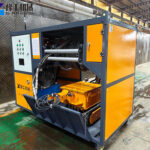
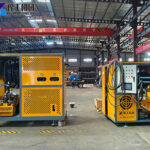
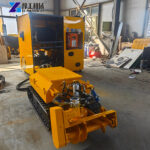
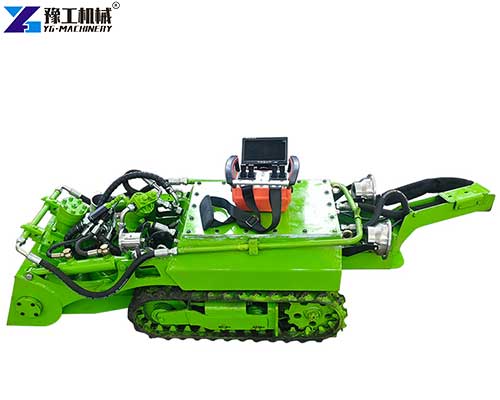
For this project, the customer selected an electric crawler model suited to the basin width and sludge conditions. The robot was equipped with a hydraulic power station, slurry pump, control cable, discharge pipeline, underwater LED lighting, and a remote-control system.
Key configuration features included:
- Tracked underwater chassis for stable movement on soft and uneven sediment.
- Hydraulic drive for reliable torque in dense sludge.
- Interchangeable working tools, including a stirring-suction head and a crushing-auger head.
- Slurry pump for transferring sediment-laden water through the discharge pipeline.
- Wireless remote control for safe operation from outside the confined space.
- Underwater LED lights and optional camera for visual monitoring.
- Optional explosion-proof motor configuration for hazardous industrial environments.
The selected system can operate at underwater depths of 30–60 m, depending on site conditions and configuration. Its tracked design and modular tooling make it suitable for tanks, sedimentation basins, pump stations, ponds, channels, and large-diameter pipelines.
How the Underwater Dredging Robot Worked
The project was carried out in stages to maintain treatment continuity.
- Site assessment and deployment
The engineering team assessed sludge depth, basin geometry, solids content, and discharge distance. The crawler robot was lowered into the basin using lifting equipment, while the hydraulic station and pipeline were positioned in a safe operating area. - Remote-controlled underwater travel
The operator used the wireless control system to guide the robot across the basin floor. The tracked chassis maintained contact with the sediment surface, allowing the machine to move through soft sludge without relying on manual positioning. - Sludge loosening and crushing
The working head agitated, cut, and broke up compacted sludge. Where the deposit contained denser material, the crushing-auger configuration helped fragment solids before pumping. - Slurry extraction and pipeline transfer
The pump drew the loosened slurry into the suction line and conveyed it through the pipeline to the shore-side treatment area. The system was configured for horizontal conveying, allowing sludge to be transported away from the basin without open handling. - Sludge separation and volume reduction
At the post-treatment end, the slurry was directed to separation and dewatering equipment. This reduced the volume of material requiring disposal and helped recover water for return to the treatment process.
Throughout the operation, personnel remained outside the basin. The underwater crawler cleaning robot performed the physical cleaning work, while operators monitored progress and adjusted travel direction, tool position, and pumping performance remotely.
Results for the Chilean Customer
The project demonstrated that a crawler-based sludge cleaning machine can remove sediment without draining the basin or interrupting normal operation.
The main benefits achieved were:
- No man-entry cleaning: Workers no longer needed to enter a confined, potentially hazardous basin.
- Continuous operation: The treatment system remained in service during cleaning.
- Improved safety: Remote operation reduced exposure to toxic gases, poor visibility, and unstable sediment.
- Better sludge handling: Slurry was transferred through a closed pipeline rather than being manually handled on site.
- Reduced disposal volume: Separation and dewatering reduced wet sludge volume before transport or final treatment.
- Flexible cleaning: The robot could reach areas that were difficult or unsafe for manual cleaning.
The customer also valued the system’s modular design. Because the working head can be changed according to sludge type, the same underwater dredging robot can be adapted for future cleaning campaigns in other basins and tanks.
Why This Matters in Chile
Chile’s water challenges make efficient sludge and sediment management increasingly important. In northern Chile, mining accounts for a major share of regional water demand, while wastewater reuse projects are being developed to reduce pressure on freshwater sources and support industrial water supply.
For wastewater plants and industrial facilities, sludge accumulation reduces available treatment capacity and can affect water-recovery performance. Removing it efficiently helps maintain stable operation, protects pumps and pipelines, and supports cleaner water reuse.
Chile is also developing sludge-recovery initiatives that aim to divert wastewater sludge from landfill and convert it into agricultural fertilizer. A closed pipeline and separation-based cleaning process supports this direction by keeping sludge contained, enabling dewatering, and making downstream recovery easier.
Suitable Applications
This underwater crawler cleaning robot is suitable for a wide range of Chilean and Latin American applications:
- Municipal wastewater treatment plants.
- Sedimentation tanks, clarifiers, and sludge thickeners.
- Pump stations, wet wells, and inspection chambers.
- Industrial effluent tanks and process-water basins.
- Mining sediment ponds and water-recovery facilities.
- Chemical and petrochemical storage tanks, with optional explosion-proof configuration.
- Rivers, lakes, reservoirs, landscape ponds, and irrigation channels.
Because the robot can be configured with different suction, auger, crushing, and grabbing tools, it can handle everything from soft organic sludge to denser sediment containing grit and solid particles.
FAQs about Underwater Crawler Cleaning Robot
Q: What types of sludge can the sludge cleaning machine handle?
It can handle organic sludge, sediment, sand, grit, and compacted deposits. The exact working head, pump configuration, and conveying distance should be selected according to solids content, particle size, and site conditions.
Q: What types of sludge can the sludge cleaning machine handle?
It can handle organic sludge, sediment, grit, and some compacted deposits. The working tool and pump configuration should be selected according to sludge concentration, particle size, and debris type.
Q: Is an explosion-proof configuration available?
Yes. For chemical plants, refineries, and other hazardous industrial environments, the system can be configured with an explosion-proof motor and enhanced visual monitoring.
Q: What factors affect the cleaning efficiency of the robot?
Efficiency is mainly affected by sludge viscosity, moisture content, sand and debris levels, tank-bottom conditions, conveying distance, and pumping head. For high-sand or debris-heavy sludge, appropriate crushing and wear-resistant configurations are recommended.