admin@yugongequipment.com



It’s the third peak season month for your towable food trailer. Rust spots show up on the frame; cabinet doors get loose and fail to shut tight; the fridge struggles to keep cool on hot afternoons. You have to run the generator longer and burn more fuel just to hold the set temperature. Every hour spent fixing leaks, waiting for repairs, or staying closed equals pure net loss.
The hard truth: the cheapest towable food trailer on your quote often ends up being the most expensive asset on your balance sheet. This article breaks down the real specs and hidden costs mobile food vendors should focus on, from durability to operating expenses and long-term returns.
What Decides the Real Service Life of a Towable Food Trailer
A mobile kitchen food trailer does not simply “wear out with age”. It fails at its weakest points: the body envelope, frame, and interior finish. Whether it lasts 3 years or 10 years depends on three key engineering choices.
1. Body construction: one-piece molded sandwich panels vs. ordinary joined panels
- Sandwich panels (one-piece molded): High-density flame-retardant insulation as the core, bonded with inner and outer skins in one factory process. They feature excellent overall sealing, block air and moisture penetration, and keep insulation dry and effective over time.
- Ordinary joined panels: Multiple panels mechanically fitted together. Constant vibration plus thermal expansion and contraction widen tiny gaps. Moisture seeps into the core, weakens insulation, and causes condensation and mold.
The operational impact is straightforward. A better building envelope means refrigeration equipment does not constantly fight heat load. In practice, a well-built body can hold an internal temperature ≤5°C for 4 hours when outside temperature hits 35°C. It cuts compressor cycling and generator fuel use significantly.
2. Corrosion protection: Cathodic electrodeposition coating + salt spray test certification. Regions with heavy rain, coastal salt air, or winter road salt speed up failure for standard paint jobs. Check for these details:
- Cathodic electrodeposition (e-coat) on the frame and critical steel parts, supported by ISO 9001-certified 720-hour neutral salt spray test reports. Compared with regular paint or powder coating, e-coat resists rust far better in wet conditions and avoids corrosion within 1–2 years.
For vendors, corrosion is not just a cosmetic issue — it is a structural risk. Rust on the tow frame or main beam can fail annual inspections and health checks, create towing hazards, and lead to costly reinforcement later.
3. Interior wall filling: Rock wool vs. regular foam
- Rock wool: Non-combustible, moisture-resistant, dimensionally stable under high heat, with slow R-value decay. It makes it easier to meet fire and compliance rules for mobile kitchens.
- Regular foam: Lower upfront cost, but sensitive to high temperature, solvents, and moisture. It may compress or delaminate after long use, losing insulation performance.
If you have ever smelled overheated insulation after lunch rush, you understand why wall filling affects both safety and service life.
Hidden cost breakdown for commercial kitchen trailer for sale
When browsing listings for commercial kitchen trailer for sale, the listed price is never the total cost. The real expense comes from shutdown losses, compliance risks, and premature replacement.
Bent tow frame: the silent uptime killer
Thin or poorly welded tow frames flex under long road loads and develop permanent deformation over time. The consequences include:
- Pulling to one side while towing and abnormal tire wear
- Stress cracks around doors and windows
- Water leaking through once-tight seams
A more reliable solution uses a 50×4 mm full tube tow frame. Smart angle and layout spread loads, paired with a 4×4 full tube internal structure to boost overall rigidity. This is no marketing pitch; it is the foundation for stable towing after tens of thousands of miles.
Electrical and plumbing failures: calculate the loss with your daily sales
A broken water pump makes sinks unusable. A tripped circuit breaker shuts down fridges and POS systems together. For mobile food sales, one system breakdown can stop all business for the day.
Quick estimate using your own numbers:
- Average daily sales: for example, $800–1500+ (varies by menu and location)
- Single-day shutdown loss = average daily sales × number of closed days
- Add repair fees, towing charges, and lost revenue from missed event bookings
Savings skimped on wire gauge, distribution panels, pipework and fittings can vanish in a single forced closure. Professional wiring, proper grounding, and pressure-tested plumbing set the baseline for serious operators.
Compliance risk: why a mobile vending trailer often fails health inspections
A mobile vending trailer designed without food safety logic easily fails health inspections. Common issues include:
- No clear separation between raw and cooked food zones
- Countertop surfaces hard to sanitize or prone to corrosion
- Handwashing and sanitizing stations that do not meet local codes
Workstations built around HACCP (Hazard Analysis and Critical Control Points) principles separate raw and cooked items, with a logical workflow from receiving, prep, cooking, service, through cleanup. This greatly lowers cross-contamination risk and helps inspections go smoothly. It avoids forced closures and repeat inspection fees, not just passing the check.
What Specs Speed up the Payback of a Towable Food Trailer
Fast payback is no lucky guess. It comes from lower ongoing costs plus higher throughput during peak hours. These features drive ROI most effectively.
Insulation → lower power and fuel bills
Better envelope + premium insulation = less heat gain. The chain is clear:
- Fewer start-stop cycles for freezer and fridge compressors
- Reduced load on generators or grid power
- Month-on-month savings on fuel, propane, or electricity
Over one peak season, the difference can add up to hundreds in operating savings, while also reducing wear on refrigeration hardware.
Kitchen workflow → one person can handle rush hour
Smart layout cuts wasted steps and collisions:
- Cold storage/fridge just one step from prep areas
- Cooking lines separate hot and cold stations without interference
- Clear pickup and packing zones to prevent crowding around cooktops
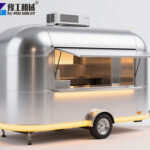
When your towable food trailer lets one crew member serve orders smoothly during rush, you either serve more customers per hour or skip extra hires. Both improve gross margin directly.
Surfaces and flooring → less cleaning time, lower labor cost
- 201 stainless steel cabinets: corrosion-resistant, easy to wipe down, stands up to daily knocks.
- Anti-slip aluminum tread plate flooring: waterproof, oil-resistant, built for heavy foot traffic and meets safety requirements.
The gains show in daily operation: shorter post-service cleanup, less sanitizer use, and fewer slip hazards. For small teams, saving 20–30 minutes each day adds up to meaningful labor savings and better work-life balance.
Contact YG
For mobile food businesses, a towable food trailer is not a one-time purchase. It is production equipment you rely on every day for the next 3–5 years. Body craftsmanship, anti-corrosion performance, wall materials, tow frame design, and dependable electric/water systems — these seemingly technical details ultimately determine repair frequency, shutdown days, energy bills, and inspection pass rates.
As a professional food trailer supplier, we prefer to work through three core calculations with you before order confirmation: durability, operating costs, and long-term returns. Share your target operating city, menu type, budget, and expected delivery timeline. We will provide a written specification proposal based on real project experience.